


What does it really mean to be an early-stage founder, particularly after the programme has ended? Whether it's Pre-aAcceleration, Acceleration, incubation or a university initiative, there's always a point at which the structure disappears. No more workshops. No more deadlines. No more weekly check-ins. That’s when execution truly begins.
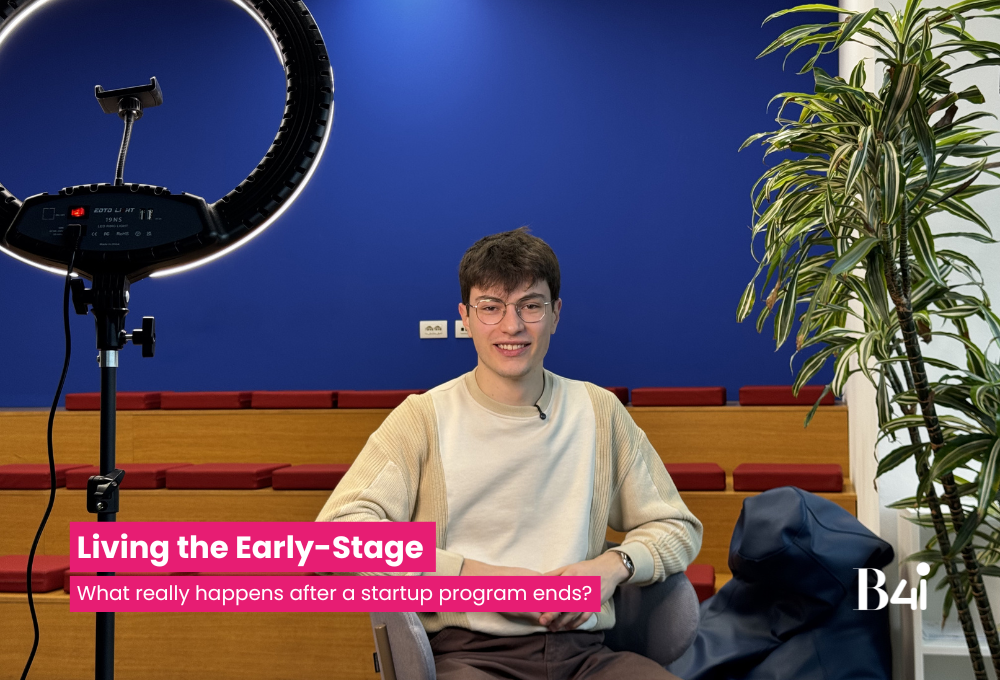
For Giacomo Dotto, a former participant in the 2025 edition of Future Founders Program, this means embracing uncertainty, questioning his own ideas daily and being prepared to adapt when necessary. Giacomo joined the program as an ambitious solo founder with technical curiosity and an undefined idea. Today, he’s building unflat, a Web3 startup that has evolved significantly since its conception.
We sat down with Giacomo to discuss the fluid mindset required in the earliest stages of a startup, the emotional dynamics of working with a co-founder, and how to turn a vision into reality.
“I applied to Future Founders Program because I wanted to build something serious. I had an entrepreneurial ambition and some early ideas in Web3, but nothing fully structured. What attracted me was the fact that you had to apply as an individual founder. It meant that you were responsible for finding the right people and shaping the idea from scratch.
At the beginning, my instinct was to look for someone similar to me. But during the first activities of the program I realized that similarity doesn’t build strong companies: complementarity does.
That’s how I partnered with Alessandro Prandini. He’s more energetic and technical, especially in blockchain. I’m more conservative and very data-driven. Before building something, I want confirmations and numbers. That balance became one of our strengths.
What surprised me most was how much responsibility comes with shared decision-making. When you build something with someone else, it’s no longer just your risk. Every choice - whether pivoting, investing time or changing direction - affects the other person’s future too. In the past, I used to start projects with friends and then look for co-founders. Now it’s the opposite. The relationship starts from work, from responsibility. The friendship comes later. That shift changes the way you approach decisions.”
“Initially, our team wanted to create a secondary market for tokenized assets, bringing liquidity to an illiquid Web3 market. The opportunity seemed interesting, and there appeared to be real demand. However, the more we researched, the more we realized that the infrastructure wasn’t ready. Even though the idea made sense in theory, the ecosystem was not mature enough to support it. So, rather than forcing it, we moved one layer down and focused on a more fundamental issue: liquidity deposits.
Today, unflat is an application that enables users to deposit euros and dollars in a straightfoward, transparent and secure way. We remove technological complexity and automate the financial layer by selecting protocols to minimize risk. One of the biggest challenges is to simplify something inherently technical for a mass audience. We are not chasing extreme returns; we focus on stability and trust. In a sector where trust has often been damaged by unrealistic promises, building credibility is part of the product itself.
That pivot reinforced something I strongly believe: you should never be completely certain about your idea. You have to keep questioning it, and if the data goes against you, you must be ready to change direction. I constantly question what we are building, and I think that’s healthy.”
“I rely heavily on metrics. If the numbers show that something isn’t working, you need to listen. In early-stage startups, insecurity is part of the process.
On a personal level, I’ve developed much greater discipline. The most challenging part has been learning to work hard without external pressure. No one forces you. No one can guarantee the outcome. It’s no longer just a hobby; it’s a real responsibility."
“When the program ends, you lose the structure, but gain ownership. That’s the real shift. We launched our minimum viable product (MVP) and validated the core idea. Now, the challenge is to bring the product to market. We have some early technical users, but our product is B2C. The next step is to build a scalable strategy to reach a broader audience.
If I could go back to day one, I would tell myself to jump in. At first, I was afraid of not finding the right person or investing time in something that wouldn't get off the ground. I doubted whether everything could really come together in such a short time. But it did. I’ve also learned that uncertainty is part of the process. The program provides a foundation. It's how you execute it that defines your success.”