



Founders often approach fundraising as a process of convincing investors to believe in their vision. In reality, understanding the incentives and constraints that drive venture capital firms is just as important as perfecting a pitch deck. The structure of a VC fund, the expectations of its limited partners and the mechanisms through which investors generate returns all shape the way investment decisions are made, and substantially influence which companies receive funding.
For entrepreneurs, this knowledge is more than a financial curiosity. It can determine whether a fundraising process leads to a productive long-term partnership or to a misalignment of expectations that emerges only after the investment is completed. Knowing how venture capitalists think enables founders to negotiate more effectively, select the right investors and build businesses that are aligned with the realities of institutional capital.
The insights explored in this article are drawn from a session led by Nico Valenti Gatto, Operating Director at B4i with 12 years of experience in VC investing, and Valentina Bocca, Investment Director at B4i Fund with more than 20 years of experience in the VC industry. Rather than focusing on fundraising tactics alone, they offered a behind-the-scenes perspective on the economic incentives and strategic considerations that influence every investment decision.
One of the most common misconceptions among first-time founders is that venture capital firms simply allocate their own capital to promising startups. In reality, investing is only one part of a much broader business model.
Before writing a single cheque, VC firms must first raise capital from their own investors — known as Limited Partners (LPs) — which can include institutional investors, corporations, pension funds and family offices. This fundraising activity shapes almost every subsequent investment decision. As Nico Valenti Gatto explained during the session, a venture capital firm is constantly balancing two responsibilities: identifying high-potential startups while ensuring it can ultimately generate attractive returns for the investors who entrusted it with their capital.
This perspective fundamentally changes the founder–investor relationship. When pitching to a VC, entrepreneurs are not simply asking for funding; they are proposing an opportunity that the fund believes can eventually return capital to its LPs and justify the trust placed in the investment team.
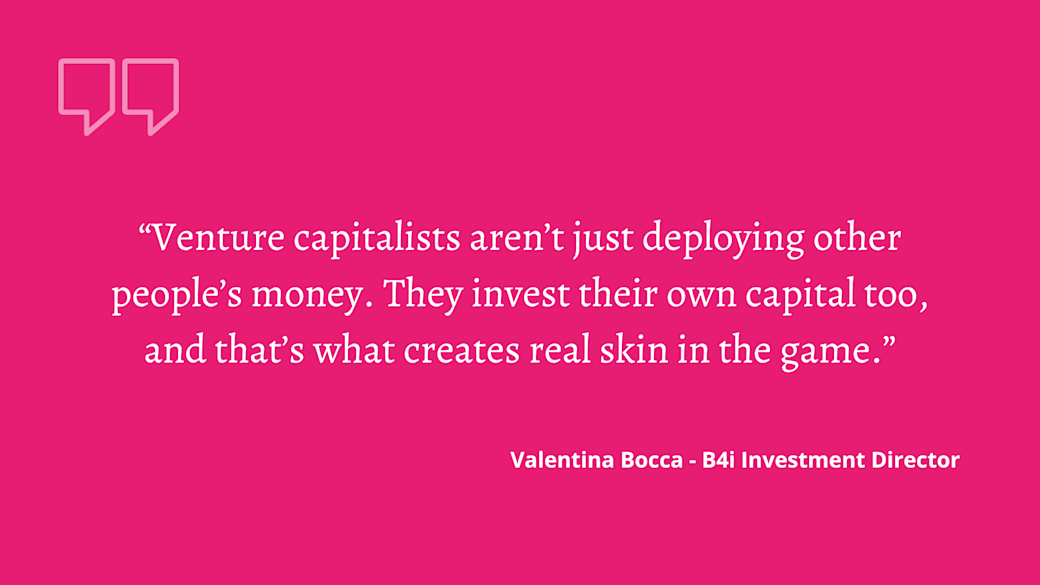
As Valentina Bocca also pointed out, venture capitalists are often perceived as professionals who merely deploy other people's money. In reality, fund managers typically have significant personal exposure through their own commitments to the fund, creating what the industry calls "skin in the game." This alignment of interests means that investors themselves bear meaningful financial risk alongside their LPs, reinforcing the pressure to back companies capable of generating exceptional outcomes.
 2
2Once founders understand how a venture capital fund is structured, another key question becomes easier to answer: why are VCs so obsessed with growth?
The answer lies in the economics of the asset class itself. Venture capital funds are expected not only to return the capital committed by their Limited Partners but also to generate outsized returns that compensate for the high risk of investing in early-stage companies. As Nico Valenti Gatto explained, investors first have to return the money entrusted to them — and often a minimum expected return — before they can participate in the upside through carried interest.
This mechanism has profound implications for founders. A venture capitalist is not looking for a business that can simply become profitable or generate steady cash flows. Instead, they are searching for companies capable of delivering exceptional outcomes—businesses that can grow rapidly, dominate large markets, and eventually achieve a liquidity event significant enough to return the entire fund.
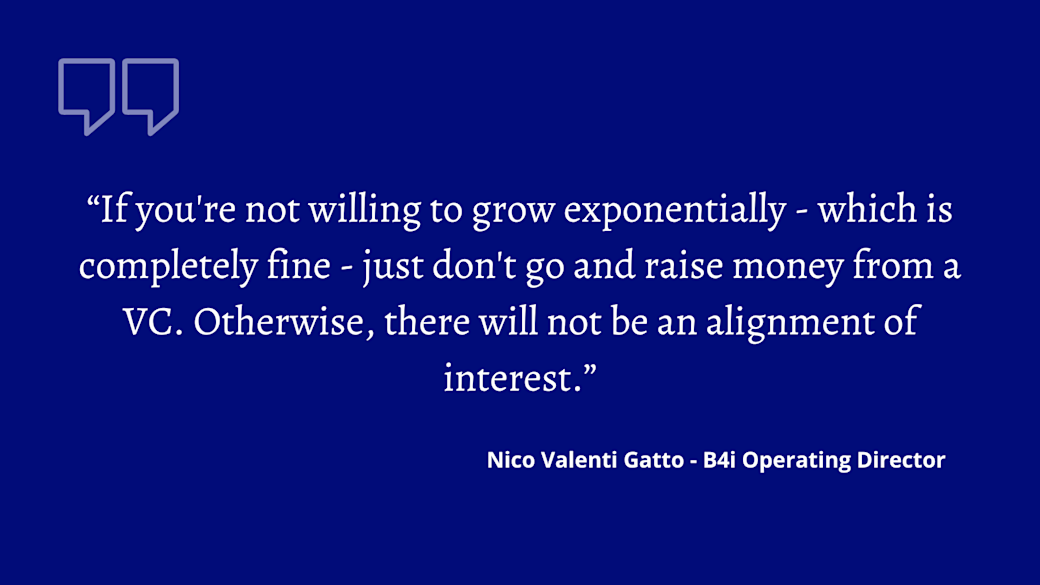
As Valenti Gatto put it during the session, “If you're not willing to grow exponentially, which is completely fine, just don't go and raise money from a VC. Otherwise, there will not be an alignment of interest.”
For founders, this is perhaps the most important takeaway of all. Venture capital is not inherently “good” or “bad”; it is simply designed for a specific type of company and a specific growth trajectory. Businesses pursuing sustainable but moderate expansion may be better served by alternative financing strategies, while startups targeting large-scale markets and rapid execution can benefit enormously from partners whose incentives are aligned with aggressive scaling.
For many first-time founders, receiving a term sheet can feel like the finish line. In reality, it is the beginning of a relationship that may last five to ten years and influence some of the most important strategic decisions the company will make.
While VCs conduct extensive due diligence on startups, founders should be just as rigorous when evaluating potential investors. Has the fund already backed companies in your industry? Can it provide access to relevant customers, strategic partners or future investors? Does it typically reserve capital for follow-on rounds, signalling a willingness to support successful portfolio companies over the long term?
Perhaps the most valuable source of information, however, comes from founders who have already worked with the fund. They can answer questions that no website or pitch deck will. Does the investor actively support portfolio companies during difficult moments? Do they make useful introductions? Are they constructive board members? Most importantly, do they behave as genuine partners once the deal is closed?
As Valenti Gatto noted, the best venture investors provide “smart money,” combining financial resources with expertise, networks, and operational support. Others may choose to remain largely hands-off, which is not necessarily a disadvantage if expectations are clear from the outset. Problems arise when founders expect strategic guidance but receive only capital.
 1
1When founders negotiate a fundraising round, the conversation often revolves around one headline figure: valuation. Yet experienced investors know that the true economics of a deal are determined by the clauses hidden in the term sheet.
Among the most important is the liquidation preference, a mechanism that defines how proceeds are distributed if the company is sold or liquidated. In its most common form — a 1x liquidation preference — an investor has the right to recover the amount initially invested before the remaining proceeds are shared among shareholders. According to Valentina Bocca, this is the market standard for healthy early-stage deals, while higher multiples are typically reserved for distressed situations or particularly complex negotiations.
The practical implication for founders is straightforward: two offers with identical valuations can produce very different outcomes at exit depending on the rights attached to the preferred shares. A seemingly attractive valuation may ultimately deliver less value to founders if accompanied by aggressive liquidation preferences or other protective provisions. The broader lesson extends beyond any single contractual clause. Every term sheet reflects an attempt to balance risk and reward between founders and investors, and entrepreneurs should understand those incentives before signing. Fundraising is not only about maximising valuation: it is about ensuring long-term alignment between all parties involved.
Before approaching venture capital investors, founders should take a step back and ask themselves a few essential questions:
Is venture capital the right financing option for my company? VC funding is designed for businesses with the ambition and potential to scale rapidly, not for every profitable startup.
Do I understand how this investor makes money? Knowing the incentives of the fund helps explain its expectations around growth, governance and exit.
Am I evaluating the investor as carefully as they are evaluating me? Speak with portfolio founders, review the fund’s track record and understand whether it can add value beyond capital.
Have I looked beyond the headline valuation? Liquidation preferences, governance rights and other clauses can have a significant impact on founder outcomes.
Are our long-term objectives aligned? The best fundraising relationships are built on shared expectations about growth, timelines and strategic direction.
And once you've done your homework, polished your pitch and read the term sheet twice... all that's left to say is: good luck with your fundraising.